
For three decades, Arm didn’t just participated in industry transformation — it redefined it. From mobile to cloud to automotive, Arm’s architecture and the AMBA ecosystem have become the backbone of scalable compute.
Now the industry faces its next structural shift:
The era of monolithic SoCs is tapering and giving way to the era of chiplet systems.
While complex SoCs are going to be continually needed, the complexity and the capacity for a single die (reticle limit) is already well past meeting system needs. As a result, performance, latency and power requirements drive these advanced systems to incorporate both complex SoCs and chiplet-based architectures that scale into much larger systems.
Arm is now building an ecosystem around the Arm Chiplet Specification Architecture (ACSA), and the recently published OCP Foundation Chiplet System Architecture (FCSA), which has helped address the problem and boost innovation and growth both within and beyond the Arm ecosystem. However, standards aren’t sufficient and system design extends beyond the Arm CSS (Compute Subsystem). Neither is focused just on processor components.
Chiplets promise:
But here’s the hard truth:
Without intelligent system-level orchestration, chiplets are just disconnected islands of silicon. The data has to move for the compute to be accessible. This needs coherent connectivity, deterministic data movement and system-wide orchestration. These are no longer implementation details — they are architectural imperatives.
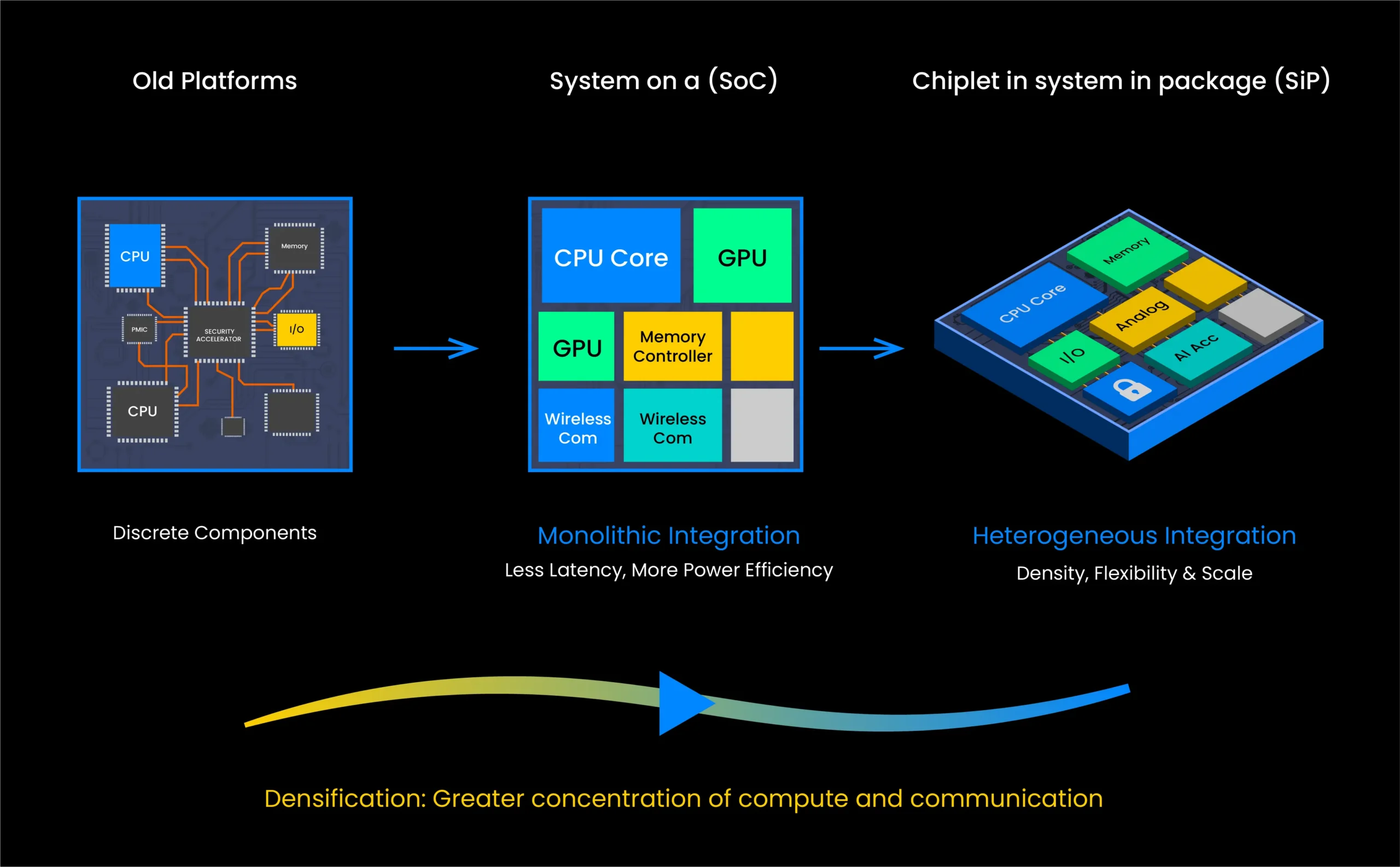
The evolution toward heterogeneous chiplet-based systems
Arm has always led through open standards like AMBA to enable scalable CPU systems that integrate diverse third-party components and spur innovation.
AMBA CHI C2C, extends coherency beyond the single die enabling chiplet-to-chiplet communication rooted in proven architectural foundations.
Baya Systems builds on that foundation.
Where Arm defines the compute architecture, system capability in AI is increasingly defined by how well and efficiently data moves. In modern AI systems, data movement is not a secondary consideration, but it determines scalability, performance, and efficiency. That’s where Baya operates: defining and orchestrating data movement across the entire system.
By aligning Arm-based platforms and AMBA CHI C2C – and extending support to inter-chiplet, transport-level CHI – with Baya’s software-defined fabric:
This goes beyond basic C2C connectivity. By supporting transport-level CHI across chiplets, Baya strengthens architectural alignment around an evolving standard, helping the ecosystem adopt it with greater confidence, an outcome that ultimately serves industry’s long-term platform interests.
This is not just interoperability. It is about looking at compute and data not as independent elements, but recognizing that to create powerful, scalable compute, we must address the whole system up front.
This is system-level intelligence across chiplets.
The industry shift toward chiplets demands more than compliance with a spec. It demands:
In distributed systems, system capability is no longer defined solely by CPU frequency. It is limited by how fast and how predictably data moves, because without access to the right data at the right time latency increases, memory pooling becomes inefficient, caching loses effectiveness, and the CPU’s potential performance is left unrealized.
Baya’s unified, software-driven fabric architecture enables:
When paired with Arm-based processing platforms, this provides a strong foundation for:
It is a structural shift.
Arm defined the architecture of scalable Compute Systems with the CSS to derisk and optimize the compute system. With Baya Systems, those subsystems can extend coherently beyond CSS, integrating GPUs, NPUs, and other specialized accelerators, potentially and scaling into large chiplet-based platforms.
Our standards-aligned, software-defined, system-level fabric that is AMBA-compliant and also customizable for proprietary protocols on the same unified transport, unlocks the next decade of intelligent silicon design.
The chiplet era will not be won by those who simply connect dies. It will be won by those who orchestrate them.
And that era starts now.
Baya is now officially part of the Arm ecosystem.
For more information visit: Arm.com/partners/catalog/baya-systems